
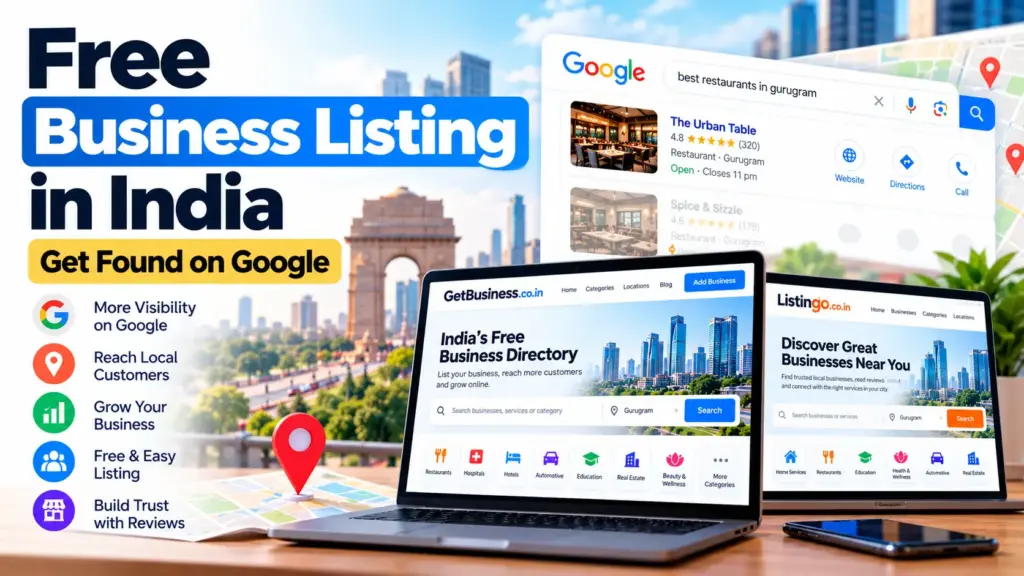
Every day, people search Google for businesses they want to hire, products they want to buy, and services they need nearby. They search for everything from a plumber in Gurugram to a manufacturer in Ahmedabad, a dentist in Delhi, or a digital marketing agency in Bengaluru.
But what happens when a good business has no meaningful online presence?
Potential customers may discover its competitors first, even when the business offers better service, competitive pricing, or more experience.
For small businesses in India, a free business listing is one practical way to improve online discoverability without immediately investing in expensive advertising campaigns.
A business listing allows you to publish essential information about your company on an online directory or business discovery platform. Depending on the platform, your profile may include your business name, category, location, contact details, website, services, photographs, opening hours, and customer reviews.
However, simply submitting your business to dozens of directories is not a reliable SEO strategy. The real opportunity comes from choosing relevant platforms, creating accurate profiles, maintaining consistent information, and giving customers a useful reason to contact you.
In this guide, I will explain how free business listings work, how to use them to support your Google visibility, which mistakes to avoid, and how platforms such as GetBusiness.co.in and Listingo.co.in can fit into a practical growth strategy.
We will also examine an illustrative case study showing how a local business could approach directory listings systematically.
What Is a Free Business Listing?
A free business listing is a public profile that allows a business to share information about its products, services, location, and contact details without paying a listing fee.
These profiles can appear on business directories, industry-specific portals, local discovery platforms, mapping services, and search-related business services.
For example, a manufacturing company might create listings on a general business directory and a B2B marketplace. A neighbourhood salon might benefit more from Google Business Profile and local consumer directories. A software development agency could use a combination of its own website, business directories, and relevant professional platforms.
A typical business listing contains:
- Business name: The actual name used by the company.
- Business category: The primary service or industry.
- Description: A clear explanation of what the business does.
- Address or service area: Where customers can visit or where services are offered.
- Contact information: A business phone number, email address, or enquiry option.
- Website: A link to the official business website, where supported.
- Products and services: Details that help potential customers understand the offering.
- Photographs: Images of the premises, products, completed work, or services.
- Opening hours: Accurate operating hours, where relevant.
- Customer reviews: Genuine feedback on platforms that support reviews.
Not every directory offers all these features. Some provide a simple company profile, while others offer categories, location filters, reviews, enquiries, or additional promotional options.
The objective is straightforward: make it easier for people to discover your business, understand what you offer, and contact you.
Why Are Free Business Listings Important for Indian Businesses?
India has businesses operating at very different levels of digital maturity. Some companies have dedicated marketing teams and established websites. Others rely on referrals, WhatsApp, repeat customers, or their physical location.
A business listing provides a relatively accessible starting point for the latter group.
1. Give customers another way to discover your business
Not every potential customer begins with your website.
Someone looking for a manufacturer, accountant, electrician, coaching centre, or interior designer may begin with a category search on a directory.
If your business has a relevant, complete profile on that platform, you have another opportunity to be discovered.
This does not mean every directory receives meaningful traffic. Its audience, search visibility, category coverage, and listing quality matter.
Before creating a profile, consider whether the platform actually helps customers find businesses like yours.
2. Support your local SEO strategy
Local SEO helps businesses become more visible for searches associated with a service, product, or geographical area.
Examples include:
- Interior designers in Gurugram
- GST consultants in Delhi
- Packaging manufacturers in Ahmedabad
- Website developers in Jaipur
- Home tutors in Noida
Business directories can contribute to your wider online presence by publishing consistent business information and providing additional discovery opportunities.
Google explains that local search results are influenced primarily by relevance, distance, and prominence. Complete business information, reviews, and information about your business across the web can contribute to Google’s understanding of your business.
However, a directory listing is not a guaranteed ranking factor, and submitting more listings does not automatically improve your Google position.
The goal is to build a credible online presence, not to accumulate the largest possible number of directory links.
3. Help potential customers evaluate your business
A listing containing only a business name and phone number gives customers very little information.
A more useful profile explains what you do, which customers you serve, what makes your offering relevant, and how someone can contact you.
For example, compare these two descriptions.
Weak description:
“We provide the best manufacturing services at affordable prices. Contact us today.”
More useful description:
“We manufacture decorative GRC jali panels for residential, commercial, and architectural projects. Our product range includes geometric patterns, custom designs, and screens for façades, balconies, partitions, and boundary walls. Contact us to discuss your design, dimensions, and project requirements.”
The second description communicates actual services and helps prospective customers determine whether the business fits their needs.
That is the purpose of a good listing: answer the customer’s questions before asking for their enquiry.
4. Establish a consistent business identity
Search engines and customers may encounter your business through several sources, including your website, social profiles, directories, and mapping services.
Consistent information helps customers recognise that these profiles refer to the same business.
Maintain a master record of your:
- Official business name
- Address, where publicly applicable
- Primary business phone number
- Website URL
- Main business category
- Opening hours
- Official business email
- Service areas
Update this information whenever it changes.
Consistency does not mean that every platform must display identical wording in every field. Descriptions can be adapted to each platform’s format. The underlying facts should remain accurate.
5. Create additional paths to enquiries
A directory listing may allow customers to call, visit your website, request a quotation, view your products, or send an enquiry.
These actions can be commercially useful even when the directory does not rank prominently on Google.
For a local service provider, one qualified enquiry may be more valuable than hundreds of irrelevant profile views.
Measure directory performance by the quality of the customers it attracts, not simply by the number of profiles you have created.
Free Business Listing Sites in India: Where Should You Start?
There is no universally correct list of directories for every Indian business.
A restaurant, a medical clinic, a wholesale supplier, and a software company have different audiences. The platforms that make sense for one may provide little value to another.
The following categories provide a practical starting point.
1. Google Business Profile
For an eligible business that serves customers in person or visits customers at their locations, Google Business Profile should generally be a priority.
It helps eligible businesses manage their appearance on Google Search and Google Maps.
Depending on the business and its eligibility, a profile can display:
- Business name and category
- Address or service area
- Contact details
- Opening hours
- Photographs
- Customer reviews
- Website and other available contact options
Start with Google’s official guidance for creating and managing a Business Profile.
Remember that eligibility rules apply. An online-only business without the required in-person customer contact may not qualify.
A complete profile does not guarantee a particular position in local search results. Google also considers factors such as the searcher’s location and the prominence of the business.
2. GetBusiness.co.in
GetBusiness.co.in is a business listing directory designed to help Indian businesses publish their profiles and become discoverable through business, category, and location searches.
It can be useful for local service providers, manufacturers, professionals, startups, and other businesses looking to establish an additional online presence.
Depending on the available listing features and selected plan, a business profile may include information such as:
- Business name and description
- Category and location
- Contact details
- Website
- Photographs
- Products or services
- Other profile information supported by the platform
Businesses can explore the available options and start with the free listing plan.
How to get started:
- Visit GetBusiness.co.in.
- Open the business listing submission option.
- Select the applicable plan.
- Enter accurate business information.
- Choose the most relevant category and location.
- Add a useful description and available photographs.
- Review the profile before submitting it.
- Keep the information updated after publication.
The value of a listing depends on the quality of the profile, its relevance to a customer’s search, the platform’s audience, and whether the listing is accessible and useful.
Creating a profile does not guarantee Google indexing, rankings, or customer enquiries.
I built GetBusiness to make online business discovery more accessible to businesses that may not have the budget for an extensive digital marketing campaign. The platform is part of a broader effort to help businesses establish a useful digital presence without making expensive advertising their first step.
For businesses that want to explore more platforms, the directory’s guide to free business listing sites in India provides an additional starting point.
3. Listingo.co.in
Listingo.co.in is another business discovery platform that allows Indian businesses to create profiles and helps customers search for businesses by category and location.
Its listing workflow supports information such as the business name, category, location, contact details, opening hours, photographs, and description.
Listingo also provides information about its listing, verification, review, and ranking practices. Businesses should read the relevant policies before submitting their profiles.
How to create a useful listing on Listingo:
- Create an account and confirm your email address.
- Open the option to add a business.
- Enter your genuine business name and relevant category.
- Add the correct address or location information.
- Provide valid contact details and opening hours.
- Write a clear description of your products or services.
- Upload photographs that you own or have permission to use.
- Review the information and publish the completed listing.
- Update your profile when your business information changes.
Listing is free, according to the platform’s published guidance. Additional promotional features may be subject to plan-specific conditions.
Listingo is worth considering as an additional discovery channel, particularly when its categories and location coverage match the customers you want to reach.
It should complement, rather than replace, your website and other relevant business profiles.
4. Industry-specific business directories
General directories are not the only option.
For some businesses, an industry-specific platform may attract more relevant prospects than a broad business directory.
Examples include:
| Business type | Platforms or channels to investigate |
|---|---|
| Manufacturers and wholesalers | IndiaMART, TradeIndia |
| Medical practices | Google Business Profile and eligible healthcare directories |
| Restaurants and cafés | Google Business Profile and relevant food discovery platforms |
| Local home services | Google Business Profile and relevant service directories |
| Professional services | Relevant professional directories and local business platforms |
| Software and IT companies | Business directories and relevant technology or agency directories |
| Retail businesses | Google Business Profile, eligible local discovery platforms, and industry-specific directories |
Availability, eligibility, free features, and commercial terms vary by platform. Check the current terms before creating a listing.
Do not submit your business to every website on a long directory list merely because the list labels them “high authority.”
A directory is useful when it serves a relevant audience, presents accurate information, and offers a credible way for customers to discover your business.
5. Your own business website
Your website is not a business directory, but it is one of the most important assets in your online presence.
Unlike a third-party listing, your website gives you greater control over your services, portfolio, contact details, content, and customer experience.
A business website can include:
- A dedicated page for each major service
- A contact page with accurate business information
- Relevant location pages
- Project examples and case studies
- Product specifications and photographs
- Frequently asked questions
- Customer testimonials published with permission
- Clear enquiry and quotation forms
Directories can help people discover your business. Your website can then provide the additional information they need to evaluate your services.
For a long-term digital strategy, build an owned website and use relevant directory listings to support its discoverability.
How to Create a Business Listing That Actually Helps
Creating a profile takes only part of the work. The quality of that profile determines whether it gives potential customers enough information to take the next step.
Use the following process.
Step 1: Choose the correct business name
Enter the actual name of your business.
Do not add a list of keywords, city names, promotional claims, or unrelated services to the business name field simply to influence search results.
For example, if your business is called “Sharma Electricals,” do not rename it “Sharma Electricals Best Electrician in Delhi Cheapest Electrical Repair.”
Such keyword stuffing can reduce credibility and violate the rules of some platforms.
Use your description and service fields to explain what you offer.
Step 2: Select the most relevant primary category
A category helps customers and directory systems understand the type of business you operate.
Choose the category that best represents your main offering.
A manufacturer of decorative GRC panels should not select unrelated categories simply because those categories appear popular.
If the platform allows secondary categories, use them only when they accurately represent genuine services.
Step 3: Write a specific business description
Avoid generic claims such as “best quality,” “number one,” or “leading company” unless you can substantiate them and the platform permits them.
A useful description should answer four questions:
- What does the business do?
- Who are its customers?
- Which products or services does it provide?
- How can a potential customer take the next step?
For example:
Business: Local web development agency
“We design and develop websites for small businesses, professional service providers, and growing companies. Our services include business websites, WordPress development, website redesigns, performance optimisation, and ongoing maintenance. Contact us to discuss your requirements, timeline, and budget.”
This is more informative than repeating a city name and a list of search keywords.
Step 4: Keep contact details accurate
Check your phone number, email address, website URL, and location before publishing.
A listing that directs customers to an inactive phone number or a broken website creates friction and wastes potential enquiries.
If your business has multiple branches, ensure that the information for each location is correct.
Do not create multiple profiles for the same business location to occupy more directory positions.
Step 5: Add genuine photographs
Photographs help customers understand what they can expect from your business.
Depending on your industry, useful images may include:
- Your storefront or office
- Products you manufacture or sell
- Completed projects
- Equipment and facilities
- Your service team, with appropriate permission
- Before-and-after project photographs
- Work samples or portfolio images
Use images that represent your actual business.
Do not present stock photographs as pictures of your premises, products, staff, or completed projects.
Step 6: Explain your services clearly
A broad description of your industry is rarely enough.
If you offer several distinct services, describe them separately where the platform supports it.
For example, an IT company might provide:
- Website development
- WordPress maintenance
- E-commerce development
- API integration
- Website performance optimisation
A prospective customer searching for API integration has a more specific requirement than someone searching for an IT company.
Clear service descriptions help customers determine whether you are a suitable provider.
Step 7: Encourage genuine customer reviews
Reviews can influence how prospective customers evaluate a business.
Ask customers to share honest feedback after a genuine transaction or service experience.
Do not purchase reviews, manufacture customer identities, or offer incentives in exchange for positive ratings. Avoid review practices that violate the policies of the relevant platform.
Respond professionally to feedback, including negative reviews. A useful response acknowledges the concern and explains the appropriate next step without disclosing private customer information.
Also remember that reviews on a third-party directory and reviews on Google are not interchangeable. Each platform has its own review system and policies.
Step 8: Keep your listing active and accurate
Review your profiles periodically.
Check whether:
- Your contact information is still correct.
- Your opening hours reflect reality.
- Your services and products have changed.
- Your website links still work.
- Your business has moved.
- Your photographs are current.
- You are responding to relevant enquiries.
- Your business is still represented accurately on each platform.
A listing should be treated as a business asset that needs maintenance, not as a one-time SEO submission.
How Do Business Listings Help You Get Found on Google?
This is where expectations need to be realistic.
A business listing on a third-party directory and a Google Business Profile are different things.
A third-party directory publishes your information on its own website. Google may discover and index that page, but it does not have to index every listing.
A Google Business Profile is managed through Google’s own business platform and can influence how an eligible business appears on Google Search and Maps.
Your own website is another separate asset that Google can crawl and index.
These three channels serve related but different purposes.
1. Your directory profile may appear in organic search
A directory page may appear when a user searches for a business, service, or category.
For example, someone might search for “GRC jali manufacturer in Gurugram.”
If a directory has a useful page about a relevant business, that page could be eligible to appear in organic search results.
However, inclusion is not guaranteed. Search engines determine which pages to crawl, index, and display.
The directory’s reputation, page quality, relevance, and technical accessibility can all affect whether a page is useful and discoverable.
2. Consistent information supports business identification
When a business publishes accurate information across its website and relevant platforms, customers can more easily recognise the business and verify its details.
Consistency is especially important for the official name, address, phone number, website, and operating hours.
If the business moves or changes its primary phone number, update the affected profiles.
3. Relevant links can help people navigate to your website
Some directories allow a link to your official website.
A visitor may follow that link to examine your portfolio, compare services, or request a quotation.
A directory link can also help search engines discover a page, depending on how the link and page are implemented.
However, not every directory link passes ranking signals. Links may be marked as sponsored or nofollow, and Google’s policies discourage creating links primarily to manipulate rankings.
Do not pay for a large volume of low-quality links or assume that a listing will improve rankings simply because it includes a backlink.
4. A strong local presence can build trust
A consistent business presence across relevant platforms gives customers more opportunities to confirm basic details and learn about your services.
This is particularly useful when someone has never heard of your business before.
Trust is not created by the number of directory profiles alone. Accurate information, genuine photographs, credible reviews, useful website content, and professional customer communication matter more than the raw count of listings.
5. Listings can generate enquiries even without top rankings
Suppose a directory visitor finds your business while browsing a relevant category.
They open your profile, read your services, and contact you.
That enquiry can be valuable even if the directory page is not the first result on Google.
This is why directory performance should be measured through actual customer actions rather than ranking claims alone.
How Many Free Business Listings Should You Create?
There is no universal number that guarantees good SEO results.
Creating 100 profiles on irrelevant or low-quality websites is not necessarily better than maintaining 10 carefully selected profiles.
A practical starting point is to create and maintain a small group of relevant listings, then expand based on the quality of the platforms and the results you observe.
For example, a local service business might begin with:
- Google Business Profile, if eligible.
- GetBusiness.co.in.
- Listingo.co.in.
- Two or three relevant industry or local directories.
- Any additional legitimate platform frequently used by its customers.
This is a starting framework, not a ranking formula.
The right number depends on your industry, customer behaviour, location, and the effort required to keep each profile accurate.
Prioritise quality over quantity
Before submitting your details, ask:
- Does this platform serve my target customers?
- Does it accept legitimate businesses in my industry?
- Are its business listings accessible and useful?
- Can I provide accurate information?
- Does the profile provide a meaningful way to contact my business?
- Can I maintain the profile over time?
- Are its listing and link policies transparent?
If you cannot identify a clear benefit, skip the platform.
Your time is better spent improving your website, strengthening a relevant listing, or responding to an actual customer enquiry.
Case Study: How a Local GRC Jali Manufacturer Could Build Online Visibility
Case study type: Illustrative scenario, not a measured customer-results report.
Consider a small GRC jali manufacturer operating in Gurugram.
The company produces decorative architectural screens for homes, commercial buildings, boundary walls, façades, and interior partitions.
It has years of practical manufacturing experience and a portfolio of completed work. Most new customers, however, come through referrals, architects, contractors, and existing relationships.
The company wants to reach additional customers who search online for products such as decorative GRC panels, architectural screens, or GRC jali manufacturers in Gurugram.
Instead of immediately spending heavily on advertising, the company develops a structured online presence.
The initial problem
The company has several weaknesses:
- Its business information is incomplete across online platforms.
- Its website does not clearly explain every major product category.
- Its photographs are scattered across different devices and messaging applications.
- Potential customers cannot easily find examples of completed projects.
- Its online profiles do not consistently explain the areas it serves.
- It has no systematic process for tracking enquiries from different sources.
The problem is not necessarily the quality of its products. The problem is that potential customers have limited information with which to discover and evaluate the company.
Phase 1: Establish an accurate business identity
The company creates a master business information sheet containing its official name, address, phone number, website, opening hours, categories, and service areas.
It uses this information to create or update its eligible Google Business Profile and relevant directory listings.
It also creates profiles on GetBusiness.co.in and Listingo.co.in, using the available fields to explain its products and business location.
The company avoids keyword-stuffed business names and duplicate profiles.
Phase 2: Improve the quality of each profile
The business prepares a set of genuine photographs showing:
- Decorative jali designs
- Different panel patterns
- Installed products
- Manufacturing capabilities
- Completed residential projects
- Commercial and architectural applications
It writes a clear description of its products and the types of projects it undertakes.
Where appropriate, it explains which designs can be customised and what information customers should provide when requesting a quotation.
This helps prospective customers understand the company’s capabilities before contacting it.
Phase 3: Improve the business website
The company updates its website to include dedicated sections for major product categories.
For example:
- Decorative GRC jali panels
- Geometric architectural screens
- Custom-designed jali patterns
- Exterior façade applications
- Project photographs and completed installations
Each page provides useful product information rather than repeating the same generic description.
The company also adds a clear enquiry form and contact details.
Phase 4: Connect discovery with enquiry tracking
The business begins recording how prospective customers discover it.
Its enquiry log includes:
| Field | Example |
|---|---|
| Enquiry date | Date received |
| Customer requirement | Decorative GRC panels |
| Customer location | Gurugram |
| Discovery source | Directory, Google, referral, or other |
| Contact method | Phone, WhatsApp, email, or form |
| Enquiry quality | Relevant or irrelevant |
| Outcome | Quotation requested, won, lost, or pending |
Where possible, the company uses source-specific tracking links and analytics to distinguish website visits from different platforms.
It does not assume that every call or enquiry resulted from SEO. Existing referrals, offline marketing, repeat customers, and other channels may also contribute.
Phase 5: Measure results rather than making assumptions
After implementation, the company reviews the data over an agreed measurement period.
It compares the baseline with the subsequent period, accounting for seasonality and other factors where possible.
The main measures include:
- Website impressions for relevant search queries
- Clicks from organic search
- Visits to product pages
- Directory profile views, where available
- Calls and enquiry clicks
- Qualified enquiries
- Quotations issued
- Sales attributable to tracked sources
The company can then identify which improvements appear useful and which channels deserve more attention.
What would count as success?
Success would not simply mean that the company has created more directory profiles.
A more meaningful outcome would be evidence that qualified customers are finding the business, viewing relevant products, and requesting quotations.
For example, if the company receives 12 additional qualified enquiries during a measurement period, it should investigate where those enquiries originated, whether they resulted in quotations, and how many became sales.
Those figures would need to come from actual records before being reported as results.
The lesson: Directory listings are most useful when they form part of a complete discovery and conversion process. Accurate profiles help customers find information, useful website pages help them evaluate the offering, and enquiry tracking helps the business decide where to invest its time.
How to Measure Whether Your Business Listings Are Working
Do not evaluate a listing campaign solely by counting published profiles.
Track performance at three levels.
Level 1: Visibility
Measure whether your business is becoming easier to discover.
Useful indicators include:
- Google Search Console impressions for relevant queries
- Organic clicks to your website
- Search visibility for relevant service and location combinations
- Profile views or impressions, where the directory provides reliable reporting
- Referral traffic from directory pages
Search Console data reflects your website’s performance in Google Search. It does not automatically report every impression or action that happens on a third-party directory.
Level 2: Engagement
Measure whether people are taking meaningful actions after discovering the business.
Examples include:
- Visits to service pages
- Clicks on contact links
- Calls initiated from listings
- Website enquiry submissions
- WhatsApp enquiries
- Requests for quotations
- Directions requests, where applicable
Not every platform provides every metric. Use the information available, and do not treat profile views as equivalent to qualified leads.
Level 3: Business outcomes
Ultimately, the purpose of business visibility is to help the business achieve its objectives.
Track:
- Qualified enquiries
- Quotations issued
- Conversion rate from enquiry to sale
- Revenue attributable to tracked channels
- Cost of acquiring a customer
- Repeat business
A simple spreadsheet is sufficient to start.
If one directory consistently sends irrelevant enquiries while another produces qualified leads, the second may deserve more attention even if its traffic volume is lower.
Common Business Listing Mistakes That Can Waste Your Time
Mistake 1: Submitting your business to every directory you find
More listings mean more profiles to maintain.
If you create profiles on irrelevant websites and never update them, you increase the risk of outdated information and inconsistent customer experiences.
Better approach: Choose platforms based on customer relevance, legitimacy, and the quality of the listing experience.
Mistake 2: Treating directory submissions as a guaranteed ranking technique
A listing does not guarantee that your website will rank on Google, that the listing itself will be indexed, or that customers will contact you.
Better approach: Combine relevant listings with a useful website, accurate business information, strong service pages, and a consistent customer experience.
Mistake 3: Using the same generic description everywhere
Copying a short, vague description across every platform does little to help customers understand your business.
Better approach: Maintain consistent business facts but tailor descriptions to each platform’s audience and format.
Mistake 4: Stuffing keywords into the business name
Adding service terms, city names, or promotional phrases to your official business name can violate platform rules and damage trust.
Better approach: Use the genuine business name and describe services in the appropriate fields.
Mistake 5: Ignoring the website behind the listing
A directory can introduce a potential customer to your business, but the customer may still need detailed product information, examples, pricing guidance, or a quotation.
If your website is slow, confusing, outdated, or missing important details, the visitor may leave.
Better approach: Make sure your website supports the next step in the customer’s decision-making process.
Mistake 6: Buying fake reviews
Fake reviews undermine trust and can violate platform policies.
Better approach: Request honest feedback from real customers and respond professionally.
Mistake 7: Creating location pages without meaningful differences
A business serving several cities may be tempted to publish dozens of nearly identical pages with only the city name changed.
This approach risks creating pages that offer little value to visitors.
Better approach: Publish location pages only when you can provide genuinely useful information about the services available, local projects, service coverage, or relevant customer requirements.
Mistake 8: Failing to measure enquiries
A campaign can look successful because it produces impressions, profile views, or published links, while generating few qualified leads.
Better approach: Track enquiry sources and business outcomes, then use the results to refine your strategy.
How to Build a Sustainable Business Listing Strategy in 30 Days
You do not need to create dozens of listings in a single day.
A structured 30-day plan gives you time to establish accurate information, improve your profiles, and begin measuring performance.
Week 1: Prepare your business information
- Confirm your official business name and contact details.
- Prepare a standard business description.
- Select your primary and secondary categories.
- Collect genuine photographs.
- Check your website and contact forms.
- Identify the directories most relevant to your customers.
Deliverable: A master business information sheet and a prioritised list of platforms.
Week 2: Create or update priority listings
- Review your eligible Google Business Profile.
- Create or update your GetBusiness.co.in profile.
- Create or update your Listingo.co.in profile.
- Add relevant industry-specific listings.
- Check all contact information and website links.
- Record the URL and account details for each profile.
Deliverable: A small set of complete, accurate business listings.
Week 3: Improve your website
- Review your main service pages.
- Add genuine photographs and project examples.
- Improve page titles and headings.
- Make contact information easy to find.
- Test forms and mobile usability.
- Connect relevant pages through internal links.
- Check whether important pages can be crawled and indexed.
Deliverable: A website that provides useful information to people who discover the business.
Week 4: Start measuring performance
- Review available profile metrics.
- Check Search Console for relevant impressions and clicks.
- Record calls and enquiries.
- Identify the source of each qualified lead where possible.
- Correct outdated information.
- Prioritise the platforms and pages showing useful engagement.
Deliverable: A baseline report and a practical plan for the next 60 days.
Thirty days is enough to establish the process, but it is not a guarantee of ranking improvements. Search visibility and commercial outcomes may take longer and depend on competition, the website, platform quality, and other factors.
Frequently Asked Questions About Free Business Listings in India
1. What is the best free business listing site in India?
There is no single best directory for every business.
Google Business Profile is an important starting point for eligible businesses seeking visibility on Google Search and Maps. GetBusiness.co.in and Listingo.co.in are additional options for businesses seeking directory-based discovery.
The best combination depends on your industry, target customers, location, and the quality of the platforms you choose.
2. Can free business listings help my website rank on Google?
They can support your broader online presence by helping customers discover your business and by creating additional pages where your business information appears.
However, a listing does not guarantee higher rankings. Google considers many factors, and local results depend on relevance, distance, and prominence.
Prioritise accurate profiles, relevant platforms, useful website content, and a good customer experience.
3. How many business listing sites should I use?
Start with a manageable number of relevant platforms rather than submitting your business to hundreds of websites.
For many small businesses, a combination of an eligible Google Business Profile, a few relevant directories, and a strong website is a sensible starting point.
Expand only when a platform provides a credible benefit and you can maintain your profile.
4. Are GetBusiness.co.in and Listingo.co.in free?
Both platforms publish free business listing options. Check their current listing pages, terms, and plan details before submitting your business.
Additional features, such as promotional placements or enhanced profile options, may have separate conditions.
5. Do I need a website to create a business listing?
Some directories allow businesses to create profiles without an independent website.
Nevertheless, a website is valuable because it gives you greater control over your business information, service pages, portfolio, and enquiry process.
If you do not have a website yet, start with the legitimate platforms available to you and consider building an owned website as your digital presence grows.
6. What information should I prepare before creating a listing?
Prepare your official business name, contact details, category, location or service area, opening hours, description, photographs, and website URL if available.
Keep the information accurate and consistent, and ensure that you have permission to publish the photographs and other materials you use.
7. Will my business listing appear on Google immediately?
Not necessarily.
Creating a profile does not guarantee that a directory will publish it immediately or that Google will crawl and index the resulting page.
Publication, indexing, and ranking are separate processes. Follow the platform’s submission requirements and monitor your website and listing performance over time.
8. Are business directory backlinks useful for SEO?
A directory link can help visitors navigate to your website and may help search engines discover your pages.
Its SEO value depends on the context and implementation. A link from a relevant, useful directory should not be treated as equivalent to every other directory link.
Avoid mass submissions and paid link schemes intended primarily to manipulate rankings.
9. Should I pay for a premium business listing?
Only after evaluating the potential business value.
Consider the platform’s audience, available features, quality of enquiries, reporting capabilities, and the actual commercial terms.
If a free profile meets your current needs, start there. Upgrade only when you have a clear reason to expect a worthwhile return.
10. How long does it take for business listings to produce results?
There is no universal timeline.
Some directories may generate direct enquiries relatively quickly. Improvements in organic search visibility may take longer, and some listings may never generate meaningful traffic.
Track actual enquiries and conversions instead of assuming that every published profile will deliver results.
Final Thoughts: Make Your Business Easier to Discover
A free business listing can be a useful starting point for improving your company’s online presence in India.
But the objective is not to create the largest possible number of profiles or collect directory links.
The objective is to help the right customers discover your business, understand what you offer, verify your details, and contact you with a genuine requirement.
Start with accurate business information. Create complete profiles on relevant platforms. Use Google Business Profile if your business is eligible. Consider GetBusiness.co.in and Listingo.co.in as additional discovery channels. Strengthen your own website, publish useful service information, and measure the enquiries you receive.
Most importantly, build a process you can maintain.
A smaller number of accurate, useful listings supported by a credible website is a stronger foundation than hundreds of neglected profiles.
Ready to improve your business’s online presence? Start by creating or updating your profile on GetBusiness.co.in and Listingo.co.in, then build a consistent business information profile across the platforms that matter to your customers.